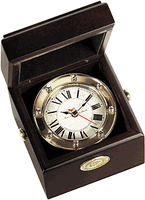
Precision clocks are traditionally named "Chronometer" (chronos is Greek for time). An accurate
marine chronometer was recognized as crucial to navigation in the 18th century. The British
Admiralty paid out the sum of 20.000 British Pounds, equivalent to a million today, for the
prototype of the first working chronometer. Longitude had to be determined by establishing
local time. Latitude was found through astronomical observation.


)